




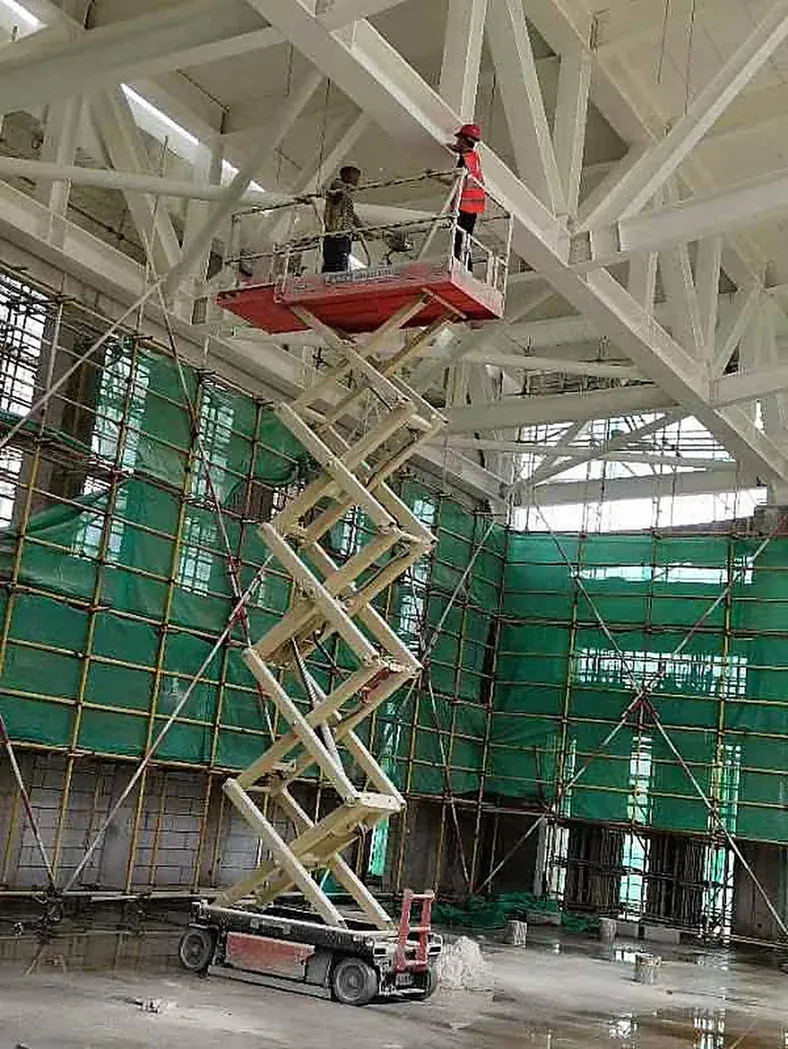

Trial assembly to 90 mCNC tube profiling Φ60–1,500Knock-down or modular
Long-Span Tubular Trusses, Box Trusses & Space Frame Structures
Pipe, box and H-section trusses and space frames for hangars, stations, atriums and skywalks. Profile-cut tube joints, shop trial assembly up to 90 m, shipped knock-down or as lift-ready modules.
90 mShop trial assembly
Φ60–1,500 mmTube profile cutting
74 mReference roof span
25–40 daysTypical lead time
01Engineering definition
Long spans without intermediate columns
A truss turns bending into axial force in chords and braces. For the same span it is lighter and stiffer than a solid girder, which is why column-free roofs over 30 m are almost always trussed. The engineering challenge moves from member size to joints: dozens of tubes meeting at angles, each needing an exact cut and a sound weld.
We cut every tube joint by CNC from the 3D model and assemble complete trusses on a surveyed bed before they leave the yard. If the truss fits in the shop, it fits on site. That is how we deliver roofs like the 74 m span at the China Aerospace Agricultural Innovation Center and the 700 t truss at Longgang Central Hospital, which was raised by hydraulic lifting.
- Pipe trusses, H and box trusses, space frames
- Lattice columns and truss girders
- Hydraulic lifting points and temporary supports detailed
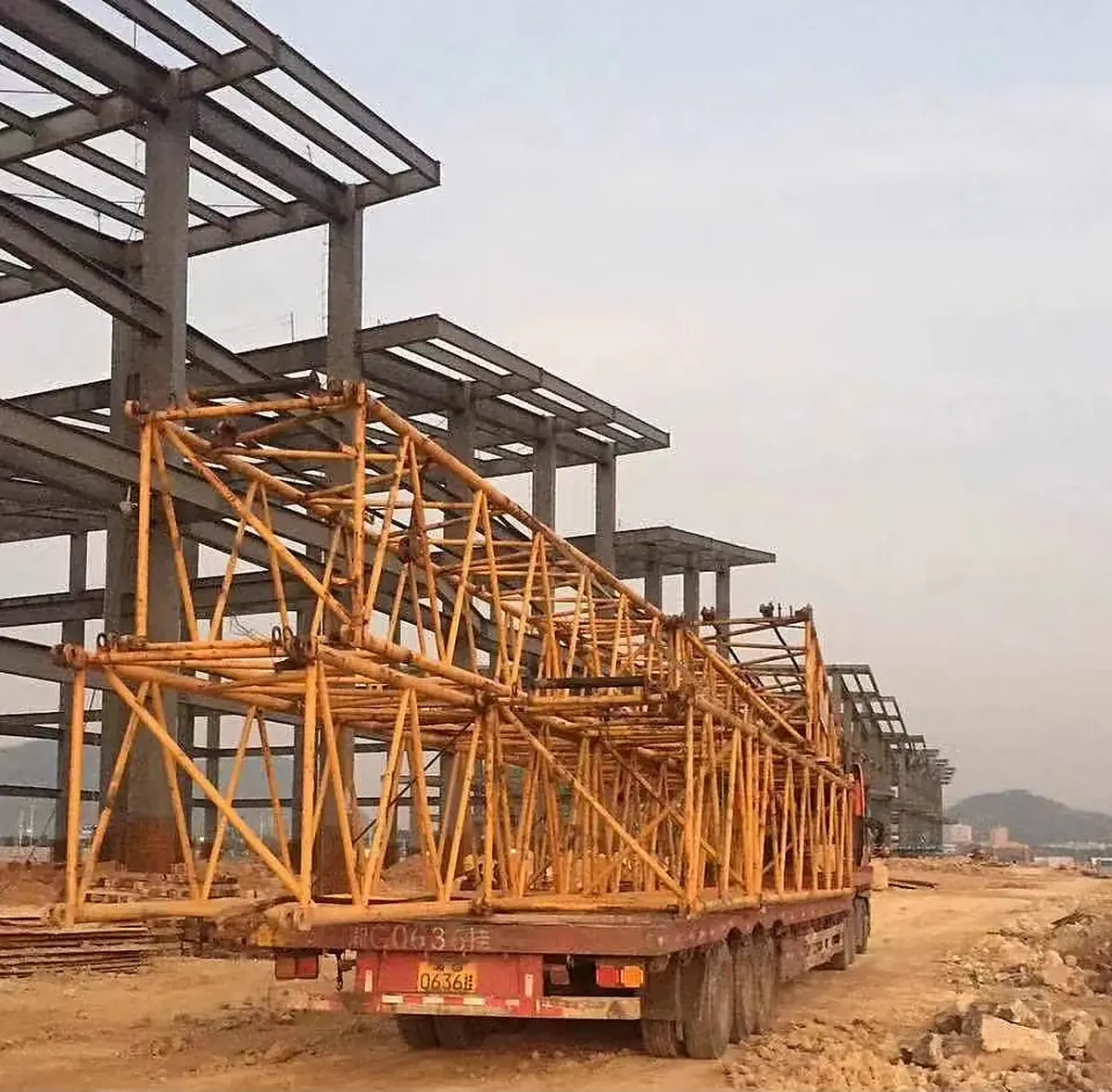
Truss trial assembly in the yard
02Section types
Four truss types and two delivery modes
Select a type to see how it is made and where it is used.
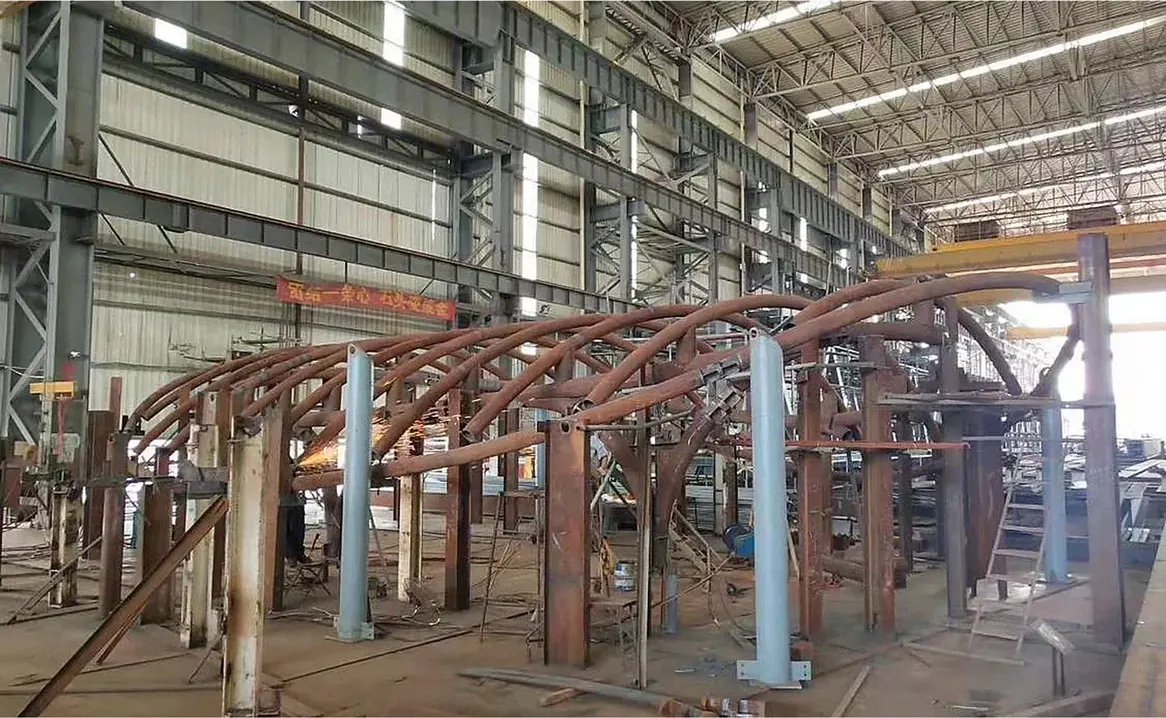
Profile-cut tube joints, no gusset plates
Brace members are cut on a 5-axis CNC tube profiler that generates the intersection curve and weld bevel from the Tekla model. Joints fit directly onto the chord, so the truss is lighter and cleaner than a gusset design. Typical for hangars, stations, stadium roofs and exposed atriums.
- Chords and braces Φ60–1,500 mm
- Planar, triangular and box-section trusses
- Curved chords rolled to the roof profile
Heavy trusses for transfers, outriggers and bridges
Built from welded or rolled H and box members with gusset or direct-welded joints. Used where loads are high: transfer and outrigger trusses in towers, conveyor trestles, crane-carrying roof trusses and truss bridges.
- Chords up to 1,800 mm box or 3,000 mm H
- Bolted or welded chord splices
- Pre-camber built into the jig
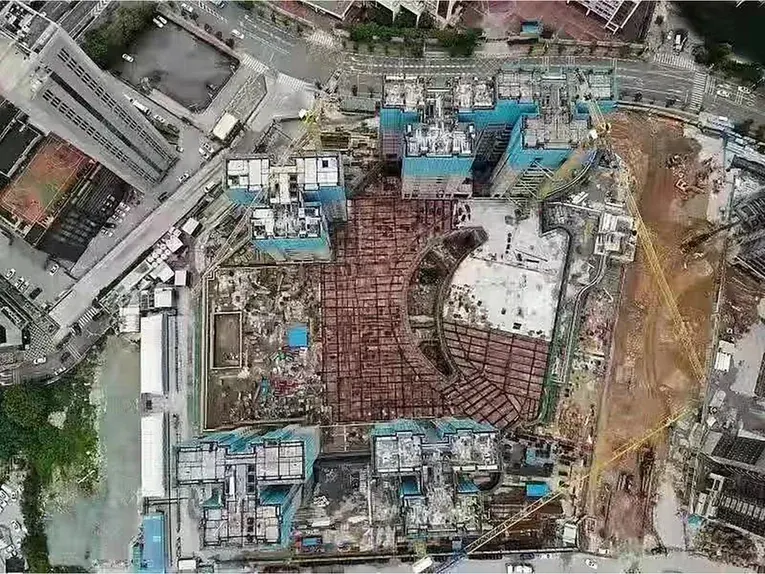
Three-dimensional grids for domes and free-form roofs
Double-layer grids of tubes and nodes, either bolted-ball or welded-hollow-sphere, cover large column-free areas with shallow depth. Each member length and node angle comes from the 3D model; nodes are numbered to their grid position.
- Bolted-ball or welded-sphere nodes
- Flat, barrel-vault and dome geometries
- Light weight per m² on large spans
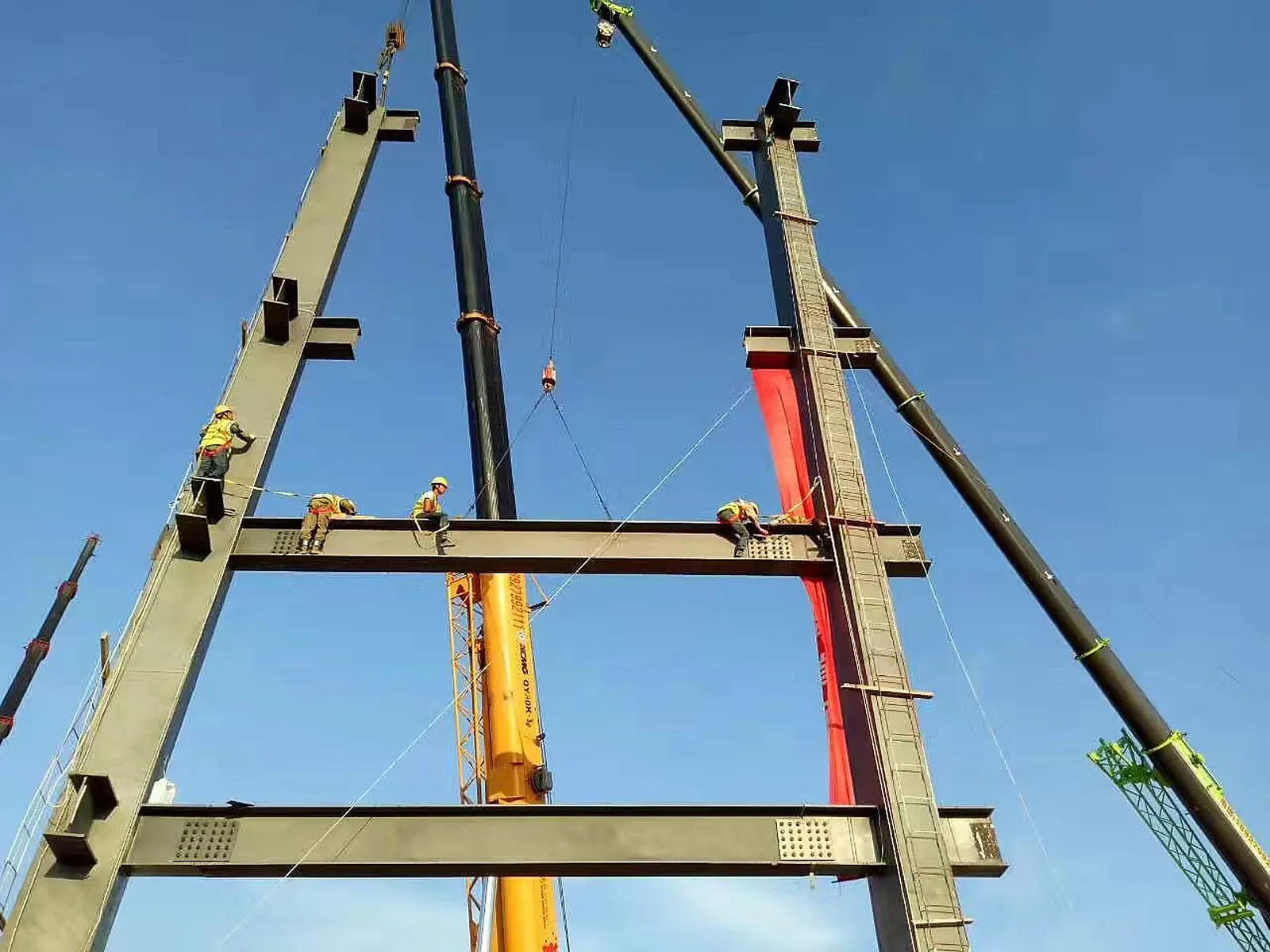
Ship in pieces or lift in one unit
Knock-down trusses ship as chords and braces in containers and are assembled on site; this is cheaper to ship. Modular trusses are welded into large units in the shop and lifted whole; this cuts site welding and time. We choose with you based on crane capacity and site space.
- Knock-down: 40HQ containers, site bolting
- Modular: break-bulk, minimal site welding
- Both trial-assembled before shipping
03Dimensional & processing limits
Truss and space frame limits
Typical values. Spans beyond 90 m are delivered as multiple trusses with designed site joints.
| Item | Limit | Note |
|---|---|---|
| Truss span, trial-assembled | Up to 90 m per truss | Longer roofs with multiple trusses and site joints |
| Truss depth | 1.5–6 m typical | Set by span, load and transport height |
| Tube profile cutting | Φ60–1,500 mm | 5-axis CNC, bevel cut with the profile |
| Chord tubes (rolled) | Φ400–3,000 mm, wall 8–80 mm | For heavy chords and mega trusses |
| Single piece length | ≤ 24 m | 11.8 m for 40HQ containers |
| Single piece weight | ≤ 60 t | Modular units split by crane capacity |
| Span tolerance after assembly | ±L/2,500, max ±15 mm | Surveyed by total station |
| Camber tolerance | ±L/5,000 of design camber | Measured at panel points |
| Node position tolerance | ±3 mm | Space frame nodes against the model |
Tolerances per GB 50205, AWS D1.1 or EN 1090-2 as specified on the drawings.
Plant limits that apply
| Item | Capability |
|---|---|
| Rolled tube columns | Φ400–3,000 mm; wall 8–80 mm; tapered tubes available |
| Max. piece length | ≤ 24 m in the shop; ≤ 11.8 m for 40HQ containers; full length by break-bulk |
| Max. piece weight | ≤ 60 t (workshop crane capacity) |
| Truss trial assembly | Single truss up to 90 m span, surveyed and match-marked |
| Cutting | CNC flame / plasma 6–150 mm; tube profile cutting Φ60–1,500 mm |
| Inspection | 100% UT on all full-penetration welds; MT/PT per AWS D1.1 / GB 50205; EN 10204 3.1 MTC |
Typical values. Final limits are confirmed per project in our quotation.
Full plant limits for every member family are in the capability table.
04Materials & welding
Tube grades and tubular joint welding
Truss chords and braces are typically Q355B (S355JR / A572 Gr.50) tube or welded section. Light braces and space frame members may use Q235B. Seamless or longitudinally welded tubes up to Φ610 are bought from mills; larger chords are rolled from plate in our shop.
Tube-to-tube joints are welded to AWS D1.1 Clause 9 (tubular structures) or EN 1993-1-8 joint rules. Full-penetration branch welds are made with a root gap set by the profile cut and tested by UT where wall thickness allows.
| Joint | Process | Test |
|---|---|---|
| Branch-to-chord (CJP) | GMAW (CO₂) | UT 100% |
| Chord butt splices | SAW / GMAW | UT 100% |
| Gusset and end plates | GMAW (CO₂) | Visual, MT sample |
| Space frame sphere welds | GMAW | UT per batch |
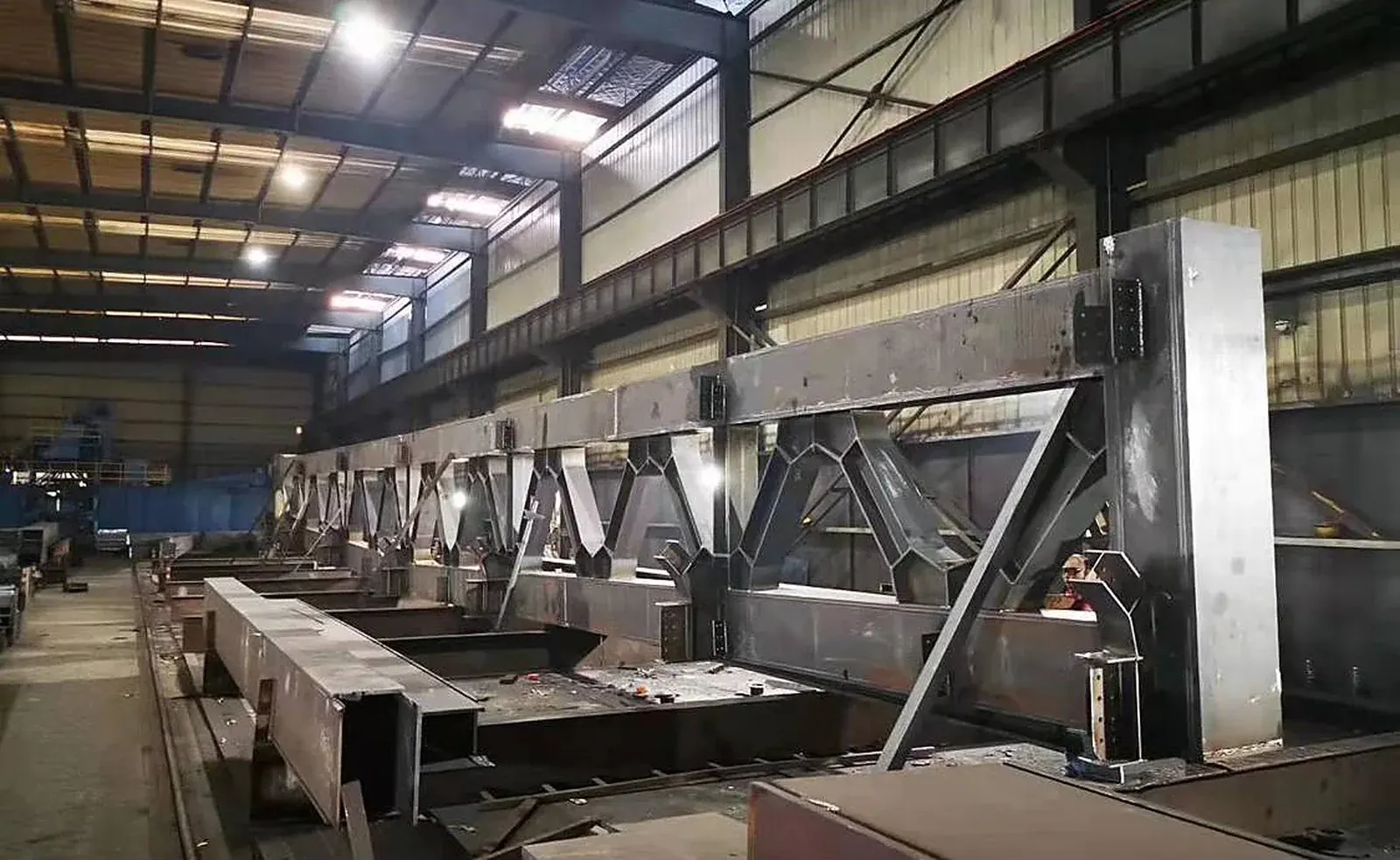
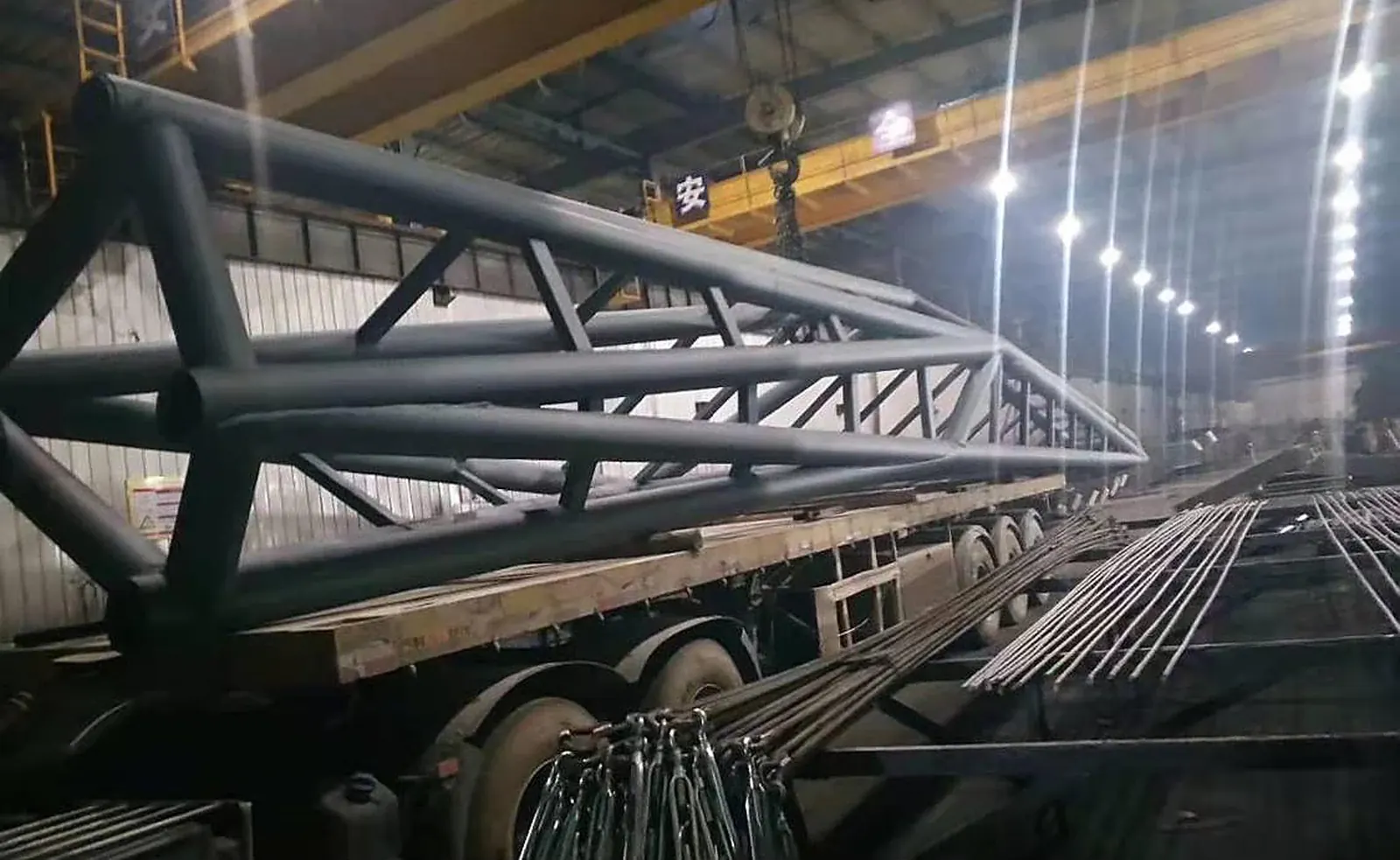
Pipe truss joints before coating
05Quality control
Proven in the yard before it ships
Assembly survey reports ship with the steel.
Shop trial assembly
Trusses up to 90 m assembled on a surveyed bed before dispatch. Joints match-marked.
Total station survey
Span, camber, sweep and support positions recorded and compared with the model.
100% UT on CJP welds
Every full-penetration branch and splice weld tested and recorded.
Assembly marks
Members tagged with grid and sequence codes that match the erection drawings.
Related services
Tekla model, connection design, shop drawings, NC files and a weight-accurate BOM.
Sa2.5 blasting, epoxy zinc-rich systems, hot-dip galvanizing and intumescent coating.
100% UT on CJP welds, dimensional reports, MTC 3.1, packing and port logistics.
06Applications
Where this member family is used
Building systems where this member family does most of the work.
07Reference project
Meihua Aviation Training Center, Guangzhou
The Meihua Aviation Training Center needed a 36 m column-free truss atrium over flight simulators. Trusses were profile-cut, trial-assembled in the shop and lifted as large units to keep site welding at height to a minimum.
For the Shenshan 750 kt grain reserve we fabricated a 50 m conveyor trestle and 47 m roof spans, and for the Antuoshan TOD cover a long-span roof over a live transport hub.
Related members
08FAQ
Truss and space frame questions
Send your drawings and our engineers reply within 24 hours.
What is the longest truss you can trial-assemble?
Up to 90 m per truss on our assembly beds. Longer roofs use several trusses with designed site joints, each trial-assembled with its neighbours.
Should I ship trusses knock-down or as modules?
Knock-down is cheaper to ship and suits container freight. Modules save site welding and time but need break-bulk shipping and larger cranes. We compare both in the quotation.
Do you design the truss or only fabricate?
Both. We fabricate to your design, or our engineers propose the truss geometry and joints and you approve before detailing. See BIM steel detailing.
Which weld code applies to tube joints?
AWS D1.1 Clause 9 for tubular connections, or EN 1993-1-8 joint rules for Eurocode projects. CJP branch welds receive 100% UT.
Can you supply space frames with bolted-ball nodes?
Yes, as well as welded-hollow-sphere nodes. Members and nodes are numbered to the grid so site assembly follows the model.
How are trusses protected for shipping?
Blasted to Sa2.5 and coated in the shop. Tube ends are capped, joints padded, and bundles strapped to frames to avoid deformation in transit.
Send your drawings. Get a 24-hour BOM and FOB price.
DWG, IFC, Tekla or PDF. Engineering review by our Tekla team, from 50 t or 2,000 m².