




H-beam, I-beam and box section are often used loosely, but they behave differently and cost different amounts to fabricate. Picking the right one is the cheapest structural optimisation available, because it happens before any steel is cut.
This guide defines each shape, compares them in one table, shows when to use each, works through a same-weight example on stiffness and torsion, and explains how shape drives fabrication cost.
- Definitions
- Comparison table
- When to use each
- Weight and stiffness example
- Fabrication cost
- Common specification mistakes
- FAQ
Written by the Guiguan Steel Engineering Team. Published October 2026. Figures are typical values and are confirmed per project in our quotation.
What is an I-beam, an H-beam and a box column?
I-beam
A rolled section with narrow, tapered flanges. The inner face of each flange slopes (about 1:6 in GB/T 706 sections, similar to US S-shapes). Flange width is small relative to depth, so the section is strong about the major axis and weak about the minor axis. Example: GB I50a, 500 × 158 mm.
H-beam (wide-flange)
Wide, parallel flanges of constant thickness. Rolled H-beams in China follow GB/T 11263 in three series: HW (wide flange, depth ≈ width, used as columns), HM (medium) and HN (narrow, used as beams). The US equivalent is the W-shape. When the required size exceeds rolled sections, we build the section from plate as a welded H or plate girder, with webs up to 3,000 mm deep.
Box column (box section)
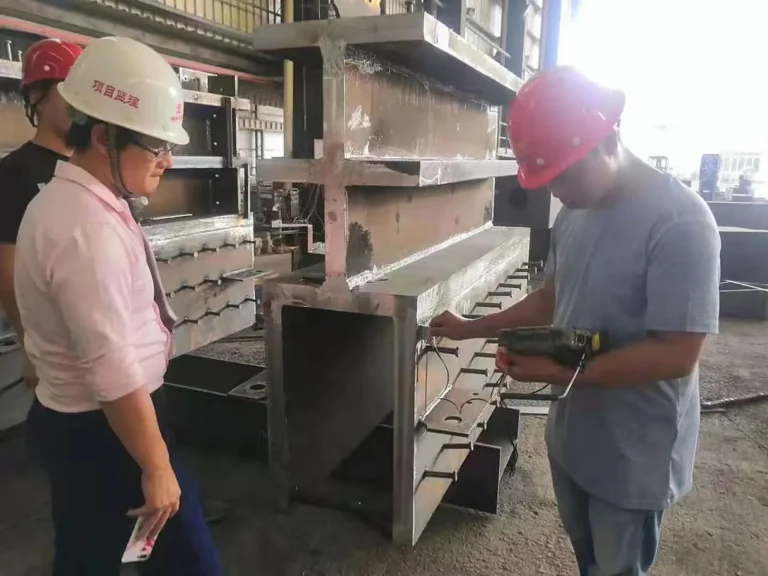
A closed rectangular or square section made from four welded plates, with internal diaphragms at beam connections. Box columns are built from plate up to 100 mm thick and up to 1,800 × 1,800 mm in our shops. They can be filled with concrete (CFT) for high-rise columns. Details on welded box columns and beams.
H-beam vs I-beam vs box section: comparison table
| Property | I-beam | H-beam | Box section |
|---|---|---|---|
| Flange | Narrow, tapered inner face | Wide, parallel | Closed, four walls |
| Typical depth | 100–630 mm (rolled) | 100–900 mm rolled; welded to 3,000 mm | 200–1,800 mm (welded) |
| Major-axis stiffness | Good | Good to very high | Good |
| Minor-axis stiffness | Low | Medium (HW high) | Equal to major axis (square) |
| Torsional stiffness | Very low | Low | Very high, 100× or more |
| Lateral-torsional buckling | Governs early | Governs on long unbraced spans | Rarely governs |
| Connections | Awkward: tapered flange needs bevel washers | Simple bolted end plates and cleats | Needs diaphragms; through-plates or site welding |
| Fire / corrosion surface | Medium | Medium | Lowest per tonne; interior sealed |
| Typical use | Light beams, monorails, lintels | Beams, PEB frames, industrial columns | High-rise and seismic columns, truss chords, bridges |
In short: the H-beam is the default for beams and most industrial columns. The box section wins where the column bends about both axes, carries torsion or must be compact. The I-beam has largely been replaced by HN sections, except for monorails and light secondary members.
When to use each section
Choose an H-beam when
- Bending is mainly about one axis: floor beams, rafters, crane girders.
- You want bolted connections with standard end plates or fin plates.
- The member can be tapered to follow the moment diagram, as in PEB portal frames.
- Spans run from 6 to about 40 m; above that, consider trusses.
Choose a box column when
- The column takes moment in both directions, as in moment frames and corner columns.
- Axial loads are high and the footprint is limited, as in high-rise cores and perimeter columns.
- Seismic design requires equal strength in both directions.
- Concrete filling is planned to raise capacity and fire resistance.
- Members carry torsion, such as curved girders, bridges and cantilevered skywalks.
Choose an I-beam when
- A monorail hoist runs on the bottom flange; tapered flanges suit many trolley wheels.
- The member is light secondary steel and rolled I sections are available locally at lower cost.
For very long spans, neither shape is efficient alone. See steel trusses and space frames, which we trial-assemble up to 90 m in the shop.
Weight vs stiffness: two worked examples
Beam: I50a vs HN500×200
| Section | Mass kg/m | Ix cm⁴ | Iy cm⁴ | Flange width mm |
|---|---|---|---|---|
| I50a (GB/T 706) | 93.6 | 46,500 | 1,120 | 158 |
| HN500×200×10×16 (GB/T 11263) | 88.1 | 46,800 | 2,140 | 200 |
Nominal section properties from the GB section tables.
The HN section is about 6% lighter with the same major-axis stiffness and almost twice the minor-axis stiffness. Its wider flange also improves lateral-torsional buckling resistance and leaves room for bolts.
Column: HW400 vs box 400 at the same weight
| Section | Mass kg/m | Ix cm⁴ | Iy cm⁴ | Torsion J cm⁴ |
|---|---|---|---|---|
| HW400×400×13×21 | 172 | 66,900 | 22,400 | about 270 |
| Box 400×400×14 | 170 | 53,700 | 53,700 | about 80,500 |
Box properties calculated for a 14 mm square box, J by thin-wall (Bredt) formula.
At the same weight, the HW is 24% stiffer about its strong axis. The box is 2.4 times stiffer about the weak axis and roughly 300 times stiffer in torsion. For a column bending in both directions, the box can be 15–25% lighter than an H section for the same capacity. For a beam bending in one direction, the H section is lighter.
How section shape drives fabrication cost
Shape decides how many hours each tonne needs. The figures below are indicative fabrication premiums over plain rolled H sections, FOB China, 2026.
| Section type | Main operations | Indicative premium USD/t | Lead time impact |
|---|---|---|---|
| Rolled H / I | Saw, drill, end plate, paint | baseline | Shortest |
| Welded H / tapered H | Plate cutting, SAW flange welds, straightening | +100 to +200 | Short |
| Plate girder, deep web | As welded H, plus stiffeners and camber | +150 to +300 | Medium |
| Box column | 4 seams, internal diaphragms, ESW, 100% UT | +250 to +450 | Medium to long |
| Multi-cavity mega column | Multiple cells, thick plate, preheat, trial fit | +500 and up | 40–60 days |
Indicative ranges, confirmed per quotation. See the full price table in our cost guide.
Box columns cost more per tonne, but may still be cheaper per building if they save tonnage. Our detailing team compares both options on request. For price-per-tonne ranges by structure type, see the 2026 cost guide. For high-rise box and mega column work, see commercial and high-rise steel and the CGN Headquarters, which used 18,472 t of steel including multi-cavity mega columns.
Four common section specification mistakes
These are the section-related issues we flag most often when we review export drawings.
Specifying sizes that are not rolled in China
US W-shapes and some European HE/IPE sizes have no exact GB equivalent. If the drawing calls for W14×90, we propose the nearest HW or HM section, or a welded H with the same depth, flange and web. Agree the substitution list before detailing starts, not after material is ordered.
Box columns without diaphragm details
A box column needs internal diaphragms at every beam flange level. If the design shows only the outer size, our detailers add diaphragms and electroslag welds to suit the connection forces and send them for approval. Diaphragm spacing also decides how the column is spliced for transport.
Ignoring the shipping length
A 14 m column that could have been spliced at 11.8 m moves the whole shipment onto flat racks. Place splices at about one-third of storey height, where moments are low, and keep pieces within 11.8 m. See the 40HQ loading guide.
Over-thick plate
Plate over 40 mm needs preheat, reduced yield values and often Z-grade material. Two thinner plates or a higher grade, such as Q420GJC, can be cheaper overall. Our grade chart lists the thickness bands.
Questions engineers ask about this topic
Need a project-specific answer? Our engineers reply within 24 hours.
Is an H-beam stronger than an I-beam?
At the same weight, an HN beam has about the same major-axis stiffness as a GB I-beam and roughly twice the minor-axis stiffness, so it resists buckling better. In that sense, yes.
What is the difference between HW, HM and HN?
They are the three series of GB/T 11263 hot-rolled H sections. HW has flange width close to depth and is used for columns. HN is narrow-flange and used for beams. HM is in between.
When is a box column cheaper than an H column?
When the column bends about both axes or carries high axial load in a tight footprint. The tonnage saving can outweigh the USD 250–450/t fabrication premium. For one-way bending, H columns are usually cheaper.
Can you match US W-shapes?
W-shapes are not rolled in China. We supply the nearest GB H-section or a welded H to the exact W dimensions in Q355B, subject to the engineer’s approval. See our steel grade chart for equivalents.