




Most buyers ask for a price per tonne first, then a price per square metre. Both are useful, but only if you know what sits behind them. A tonne of purlins and a tonne of multi-cavity mega columns are different products with different labour content.
This guide gives indicative FOB China ranges for 2026 by structure type, explains the six drivers that move the number, converts tonnes into cost per m², and works through a full 10,000 m² warehouse estimate including freight to key markets.
- FOB price per ton by structure type
- Cost per m² and per ft²
- Six cost drivers
- Worked example: 10,000 m² warehouse
- Landed cost and freight by market
- How to cut cost
- FAQ
Written by the Guiguan Steel Engineering Team. Published October 2026. Figures are typical values and are confirmed per project in our quotation.
Indicative FOB price per tonne by structure type
FOB means the steel is fabricated, blasted, coated, packed and loaded on the vessel at a Chinese port. Freight, insurance, import duty and erection are not included. For structural steel from China, the 2026 range is roughly USD 1,100–1,800 per tonne, depending mainly on how much welding and fitting each tonne needs.
| Structure type | Typical members | Indicative FOB USD/t | Labour content |
|---|---|---|---|
| Secondary steel | Z/C purlins, girts, bracing rods, flange braces | 1,100–1,250 | Low: roll-formed, punched |
| PEB portal frame | Tapered welded H rafters and columns | 1,150–1,350 | Low to medium |
| Industrial with crane | Built-up H columns, crane girders, brackets | 1,300–1,500 | Medium |
| Multi-storey frame | Rolled / welded H beams, moment connections | 1,350–1,550 | Medium |
| Long-span truss / space frame | Pipe or box trusses, trial assembly | 1,450–1,700 | High |
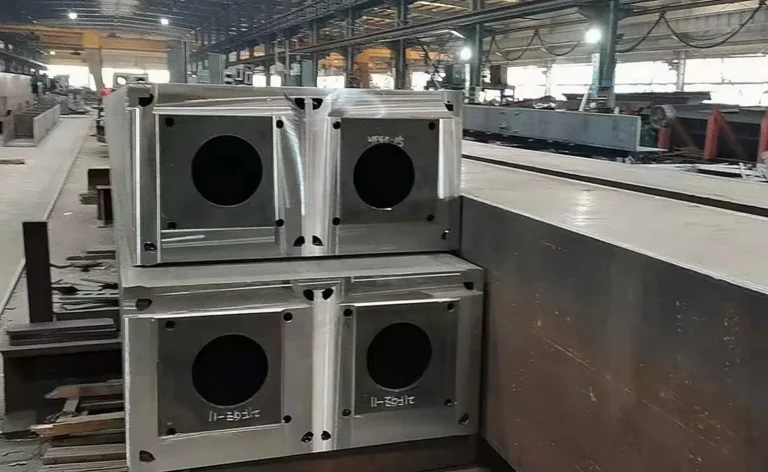
| High-rise box columns and nodes | Welded box, multi-cavity mega columns | 1,550–1,800+ | Very high |
Indicative FOB China, 2026, standard 2-coat primer + intermediate paint system (about 160–200 µm). Hot-dip galvanizing and fireproofing are extra.
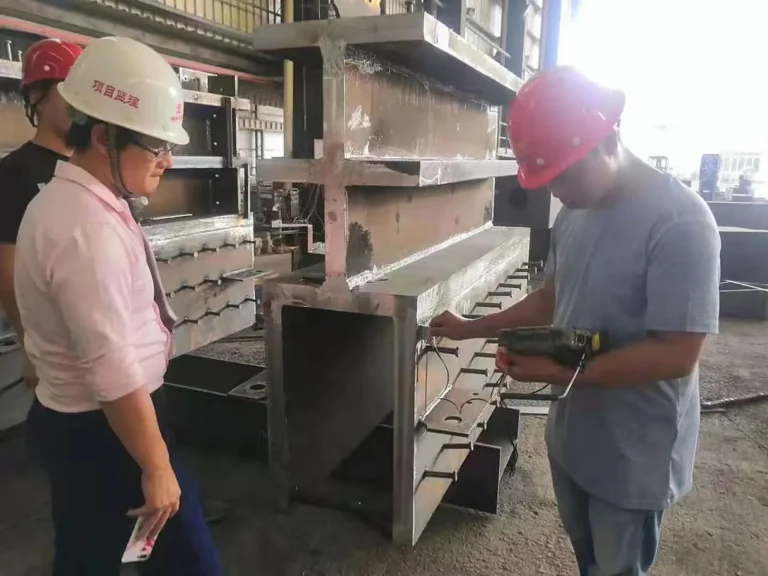
Rolled H sections and roll-formed purlins sit at the low end because mill sections need little more than cutting, drilling and painting. Welded box columns sit at the top because every metre carries four longitudinal seams, internal diaphragms and 100% UT on complete-joint-penetration (CJP) welds. See welded box columns and beams and multi-cavity nodes for what that work involves.
From price per tonne to cost per m²
Price per m² is price per tonne multiplied by steel consumption. Steel consumption is the variable most buyers underestimate. These are the tiers we see on real projects:
| Building type | Steel consumption kg/m² | Indicative USD/t | Indicative steel cost USD/m² |
|---|---|---|---|
| Single-storey warehouse, 24–40 m span, no crane | 32–45 | 1,150–1,300 | 37–59 |
| Single-storey workshop with 10–20 t crane | 45–65 | 1,250–1,450 | 56–94 |
| Clear-span hangar or exhibition hall, 50–74 m | 55–90 | 1,400–1,650 | 77–149 |
| Multi-storey office, car park or factory | 55–95 | 1,350–1,550 | 74–147 |
| High-rise steel or composite tower | 110–200 | 1,550–1,800 | 171–360 |
Steel frame only, measured per m² of building footprint (single-storey) or gross floor area (multi-storey). Indicative ranges, 2026.
What is not in the steel price
The figures above cover the structural frame. Roof and wall cladding, floor deck, doors, gutters and skylights are separate lines. As a rough guide, single-skin colour steel sheet adds USD 8–12/m² of envelope area and 50–75 mm PIR or rock-wool sandwich panels add USD 18–35/m². Our truss floor deck for mezzanines and multi-storey floors is quoted per m² separately.
For a quick per-square-foot figure, divide the USD/m² value by 10.76. A warehouse frame at USD 47/m² is about USD 4.4/ft² FOB for steel alone.
The six drivers behind every steel quotation
Six factors explain almost every difference between two quotations for the same building.
1. Raw material (55–65% of FOB)
Hot-rolled plate and sections are the largest share. Domestic Q355B plate moved in a range of about USD 480–600/t in 2025–2026. Thick plate above 40 mm, Z-grade through-thickness plate and Q420GJC cost more per tonne than standard Q355B.
2. Fabrication complexity (20–30%)
Count the pieces per tonne. A tapered rafter at 1.2 t per piece is cheap to make. A truss with 400 pipe intersections per 10 t is not. Profile cutting of pipe ends, trial assembly and tight tolerances all add hours.
3. Coating system (5–15%)
Shop primer only is the cheapest. A three-coat epoxy / polyurethane system for C3–C4 environments adds about USD 80–150/t. Hot-dip galvanizing adds about USD 220–320/t. Intumescent fireproofing is priced by required rating and section factor. Details on coating, galvanizing and fireproofing.
4. Connections and bolts
Grade 10.9 high-strength bolt assemblies, tension-control bolts and anchor bolts are usually 2–4% of the steel value. Site-welded connections lower bolt cost but raise erection cost.
5. Inspection and documentation
100% UT on CJP welds and MTC to EN 10204 3.1 are standard in our price. Third-party inspection (SGS, BV, TUV) or extra NDT scope is added at cost.
6. Order size and packing
Our MOQ is 50 t or 2,000 m². Below about 150 t, detailing and setup are spread over fewer tonnes, so the per-tonne price rises. Members cut to fit 40HQ containers pack better and lower freight per tonne.
Worked example: a 10,000 m² warehouse
This is a typical regional distribution warehouse. We use it to show how the numbers combine.
| Parameter | Value |
|---|---|
| Footprint | 125 m × 80 m = 10,000 m² |
| Frame | Two 40 m spans, interior column line, 8 m bay spacing |
| Eave height | 10 m, no overhead crane |
| Loads | Wind 0.55 kPa basic pressure, roof live 0.5 kPa |
| Grade | Q355B frames, Q235B / G550 secondary |
| Coating | Sa2.5 blast, 2-coat epoxy system, 160 µm DFT |
Step 1: estimate tonnage
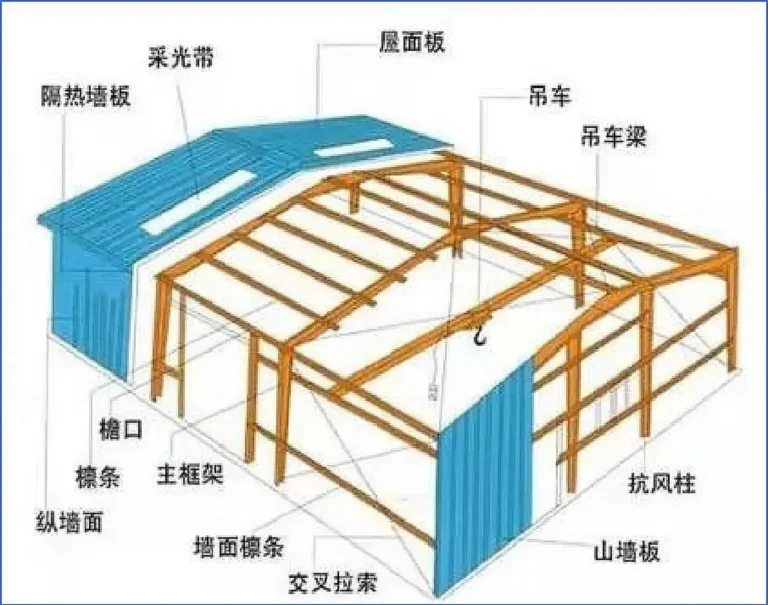
At 38 kg/m², the frame is about 380 t. Our split for this layout is about 250 t primary frames, 85 t purlins and girts and 45 t bracing, crane-free gable frames, bolts and anchor bolts.
Step 2: price each package
| Package | Tonnes | Indicative USD/t | Indicative FOB USD |
|---|---|---|---|
| Primary frames (tapered welded H) | 250 | 1,250 | 312,500 |
| Purlins and girts (Z/C, galvanized) | 85 | 1,150 | 97,750 |
| Bracing, gable steel, bolts, anchors | 45 | 1,300 | 58,500 |
| Total steel frame | 380 | 1,234 avg. | 468,750 |
Indicative FOB China, 2026. Excludes cladding, doors and freight.
The steel frame works out at about USD 47/m² FOB. Adding 50 mm sandwich panel roof and walls (about 10,000 m² roof plus 4,100 m² walls at an average USD 24/m²) brings the steel-plus-envelope package to roughly USD 807,000, or about USD 81/m² FOB.
Step 3: packing and freight
Members are detailed to a maximum of 11.8 m. Steel frames for this type of warehouse usually fill 40HQ containers on volume rather than weight, at about 21–24 t per box. The frame ships in about 17 containers. Sandwich panels are lighter and bulkier and take about 12 more. Our 40HQ loading guide shows how we plan this.
More on this building type: steel warehouse buildings, and the JD Asia No.1 smart warehouse reference project.
Landed cost: freight to key markets
Landed cost is what the steel costs at your site gate. The formula is simple:
Freight is a smaller share than most buyers expect for nearby markets and a larger one for West Africa. The table uses indicative 40HQ rates from Shenzhen in Q3 2026 at an average 22 t per container.
| Destination port | Transit days | Indicative USD per 40HQ | Indicative freight USD/t | Market page |
|---|---|---|---|---|
| Manila, Philippines | about 3 | 600–1,100 | 27–50 | Philippines |
| Port Klang, Malaysia | about 4 | 500–1,000 | 23–45 | Malaysia |
| Jakarta, Indonesia | about 6 | 600–1,100 | 27–50 | PT Xianghe installation |
| Sydney / Brisbane, Australia | 12–15 | 1,500–2,800 | 68–127 | Australia |
| Jebel Ali, UAE | 18–22 | 1,500–3,000 | 68–136 | UAE / Dubai |
| Dammam, Saudi Arabia | 20–24 | 1,800–3,200 | 82–145 | Saudi Arabia |
| Durban, South Africa | 22–28 | 2,500–4,500 | 114–205 | South Africa |
| Manzanillo, Mexico | 22–28 | 2,500–4,500 | 114–205 | Mexico |
| Lagos, Nigeria / Mombasa, Kenya | 25–45 | 3,000–6,000 | 136–273 | Nigeria & Kenya |
Indicative ocean freight only, Q3 2026. Rates change monthly. We quote CFR or CIF on request.
For the 10,000 m² warehouse frame (17 × 40HQ), freight adds about USD 1.4/m² to Manila, USD 3.7/m² to Sydney and USD 8/m² to Lagos. Import duty usually matters more than freight: check your HS code (7308.90 for fabricated structural steel) and any anti-dumping measures in your market before comparing offers.
Shipping documents, packing lists and loading photos are covered on quality, NDT and shipping.
Seven ways to cut steel building cost
Most savings come from design and detailing decisions made before fabrication. These are the levers we use most often when we value-engineer a client design.
- Optimise bay spacing. For PEB warehouses, 7.5–9 m bays usually give the lowest combined frame and purlin weight.
- Taper the members. Tapered welded H rafters and columns follow the moment diagram and save 10–20% versus constant rolled sections.
- Use Q355B where strength governs. Switching strength-governed members from Q235B to Q355B often cuts their tonnage by 10–15% for a 3–5% higher price per tonne.
- Standardise connections. Fewer end-plate and splice types mean fewer setups, faster fitting and fewer site errors.
- Match coating to the environment. Specify C3 systems inside dry warehouses and save galvanizing for exposed or coastal steel.
- Detail for 11.8 m. Splices placed to fit 40HQ containers avoid open-top and flat-rack surcharges.
- Order the whole package together. Frame, purlins, deck and cladding in one shipment share detailing, packing and freight.
Send your drawings to our BIM detailing team and we return a tonnage check and value-engineering notes with the quotation. Fabrication runs 25–40 days after shop drawing approval. For heavy or complex steelwork, see structural steel fabrication.
Questions engineers ask about this topic
Need a project-specific answer? Our engineers reply within 24 hours.
Is price per tonne or per m² better for comparing quotes?
Use both. Price per tonne shows fabrication efficiency. Price per m² shows design efficiency. A low per-tonne price on a heavy design can still cost more per m² than a lighter design at a higher per-tonne rate.
What does your FOB price include?
Material, fabrication, blasting to Sa2.5, the specified coating, 100% UT on CJP welds, MTC EN 10204 3.1, packing and loading at Shenzhen or Guangzhou port. Freight, insurance, duty and site erection are excluded unless quoted CFR or CIF.
How long is a quotation valid?
Usually 15–30 days, because plate prices move. For larger projects we can fix the material price at contract signing and order plate immediately.
What do you need for a 24-hour quote?
General arrangement drawings in DWG, IFC, Tekla or PDF, plus design loads, steel grade, coating requirement and destination port. If you only have a layout, we estimate tonnage from our steel-consumption tiers and refine it later.