





Steel Corrosion Protection, Galvanizing & Intumescent Fireproofing
Shot blasting to Sa2.5, multi-coat paint systems for ISO 12944 corrosivity C2 to CX, hot-dip galvanizing to ISO 1461 and intumescent fire protection rated 60–120 minutes. Every member leaves with a DFT record.
Coating life is decided before the first coat
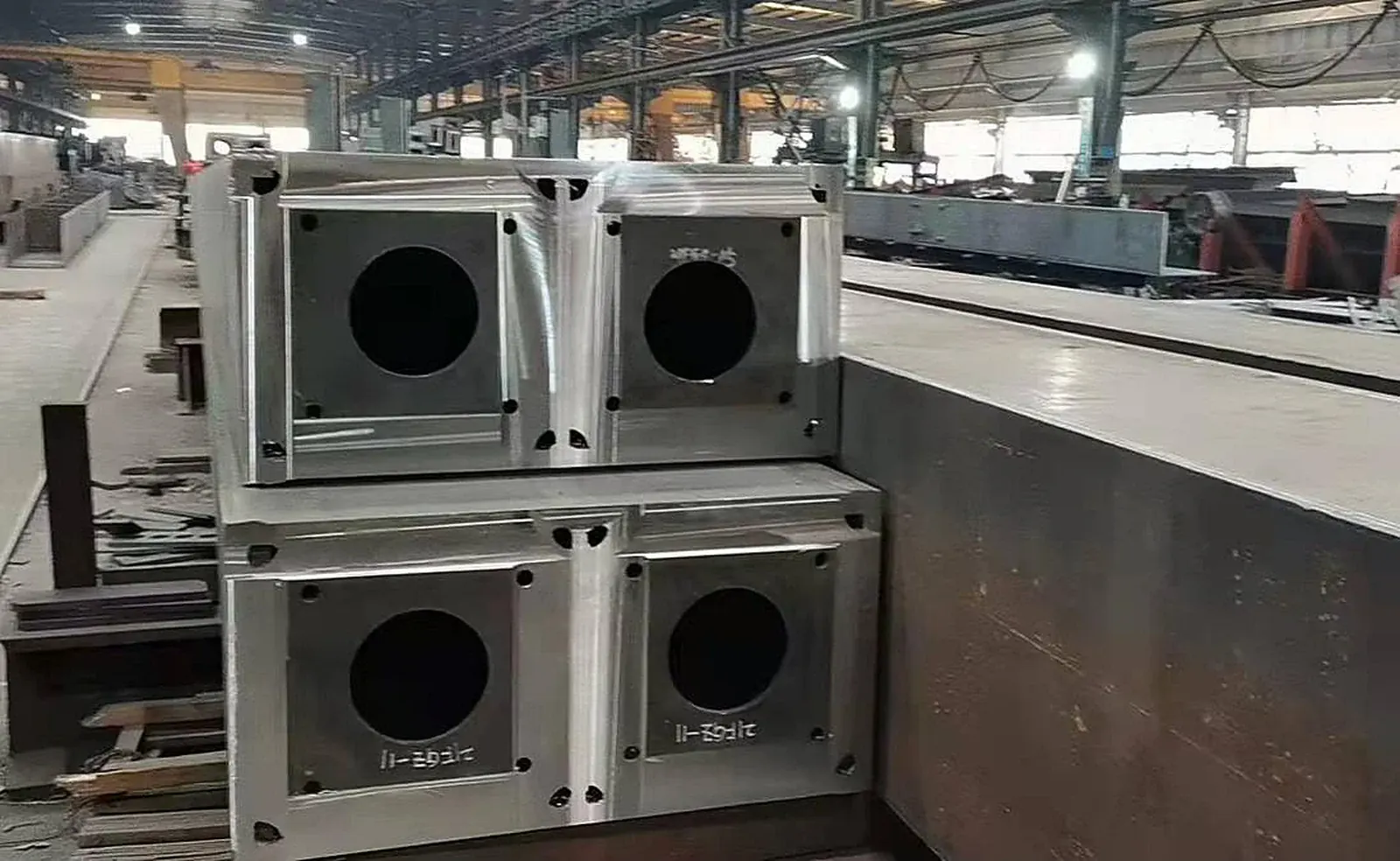
Most coating failures trace back to the steel surface, not the paint. Members pass through automatic shot blasting lines after fabrication and before priming. We blast to Sa2.5 (near-white metal, equivalent to SSPC-SP10) and prime within 4 hours, before flash rust can form in the South China humidity.
Edges and welds get extra attention. Sharp edges are ground to a radius of at least 2 mm, weld spatter is removed and laminations are dressed, so the film does not thin out where corrosion usually starts.
- Cleanliness Sa2.5 to ISO 8501-1, Sa3 on request
- Surface profile 50–85 µm (medium G) to ISO 8503
- Soluble salts below 50 mg/m² (Bresle test, ISO 8502-6/-9)
- Dust rating 2 or better to ISO 8502-3
- Edge preparation grade P2 to ISO 8501-3 for C4 and above
Paint systems by ISO 12944 corrosivity category
Tell us the site location and the design life. We propose a system and price per tonne or per m².
| Corrosivity (ISO 12944-2) | Typical environment | System (ISO 12944-5 type) | Total DFT | Durability |
|---|---|---|---|---|
| C2 Low | Dry inland warehouses, heated interiors | Epoxy primer 60 µm + PU top 60 µm | 120 µm | High (15–25 yr) |
| C3 Medium | Urban and light industrial, mild coastal interiors | Zinc phosphate epoxy 80 µm + epoxy MIO 80 µm + PU 60 µm | 220 µm | High (15–25 yr) |
| C4 High | Industrial plants, coastal areas, swimming pools | Epoxy zinc-rich 60 µm + epoxy MIO 140 µm + PU 60 µm | 260 µm | High (15–25 yr) |
| C5 Very high | Marine coast, chemical plants, ports | Epoxy zinc-rich 60 µm + epoxy MIO 160 µm + PU 80 µm | 300–320 µm | Very high (>25 yr) |
| CX Extreme | Offshore, splash zones, tropical marine industry | Zinc silicate 75 µm + epoxy tie 50 µm + glass-flake epoxy 300 µm + PU 60 µm | 480–500 µm | Very high (>25 yr) |
Typical systems. Final specification follows your project spec or the paint manufacturer system sheet. AS/NZS 2312 and NORSOK M-501 equivalents available.
Airless spray, controlled hall
Coats applied in covered halls with temperature at least 3 °C above dew point and RH below 85%.
Stripe coats
Edges, welds and bolt holes get a brush stripe coat before each full coat on C4 and above.
Connection faces
Slip-critical faying surfaces masked or coated with a slip-tested primer (class B, µ ≥ 0.40).
HDG to ISO 1461 for secondary steel and exposed frames
Galvanizing suits purlins, girts, stairs, platforms, handrails, canopies and open structures where repainting is hard. We fabricate with vent and drain holes sized to the kettle process, then galvanize through partner plants near our bases.
- Kettle length up to 13 m, single dip; longer members by double dip
- Vent and drain holes modelled in Tekla, not drilled after the fact
- Steel chemistry checked for Si + P to avoid brittle, thick coatings
- Duplex system (HDG + paint) for C5 and CX sites
- Galvanizing certificate with thickness readings per batch
See purlins, stairs and platforms for typical galvanized items.
| Steel thickness | Local min. (µm) | Mean min. (µm) | Mean min. (g/m²) |
|---|---|---|---|
| > 6 mm | 70 | 85 | 610 |
| > 3 mm to ≤ 6 mm | 55 | 70 | 505 |
| > 1.5 mm to ≤ 3 mm | 45 | 55 | 395 |
| Castings ≥ 6 mm | 70 | 80 | 575 |
ISO 1461 minimum coating thickness for articles not centrifuged. Actual thickness on Q355 plate often reaches 100–150 µm depending on silicon content.
Intumescent coatings for 60–120 minute ratings
Thin-film intumescent keeps the steel profile visible and is applied in the shop, so site work is limited to touch-up at connections.
| Fire rating | Typical member | Section factor Hp/A (m⁻¹) | Intumescent DFT (approx.) |
|---|---|---|---|
| R60 (60 min) | Beams, light columns | 150–250 | 0.6–1.5 mm |
| R90 (90 min) | Floor beams, columns | 150–250 | 1.5–3.0 mm |
| R120 (120 min) | Primary columns, transfer girders | 100–200 | 2.5–5.0 mm |
Indicative ranges for a 550 °C critical temperature. Final DFT comes from the paint manufacturer loading table for each section, tested to EN 13381-8, BS 476 or UL 263 as specified.
We take your fire strategy and the section list from the Tekla model, then the paint supplier calculates DFT per member from its approved loading tables. Members are coded by required DFT so each one gets the right thickness.
- Compatible primer system confirmed with the intumescent supplier
- Shop-applied, water- or solvent-based thin film
- Seal coat for C3/C4 exposure or external use
- Thickness log for every member, signed before packing
- Site touch-up kit and procedure shipped with the steel
Readings you receive with every coated lot
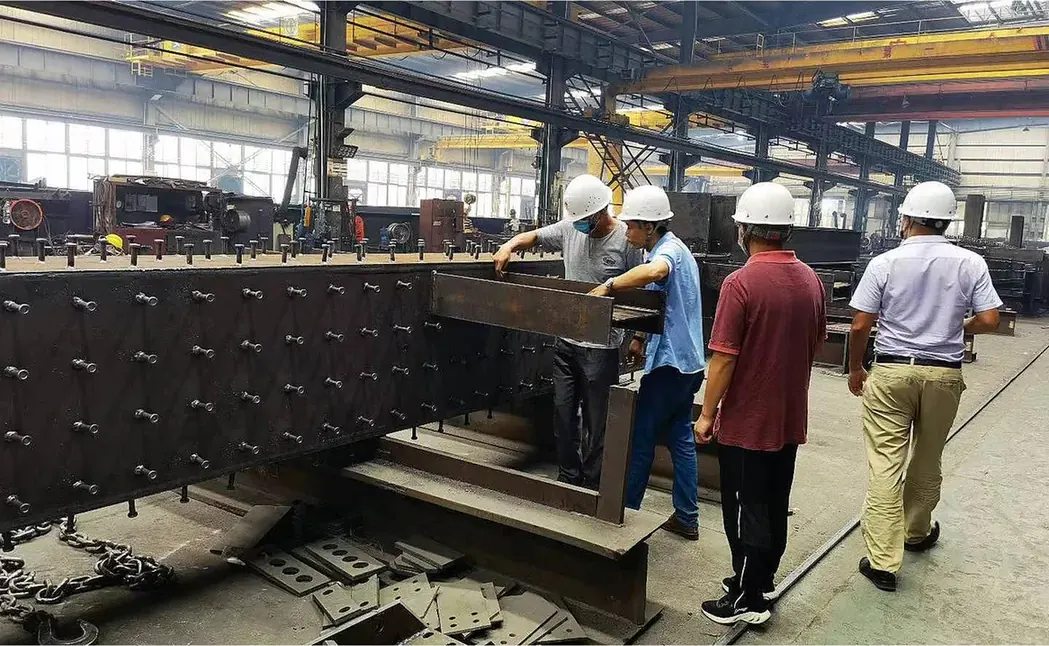
All readings are logged against the piece mark and included in the shipping dossier.
| Check | Method / standard | Frequency | Acceptance |
|---|---|---|---|
| Ambient conditions | Dew point meter, ISO 8502-4 | Every 4 h and before each coat | Steel ≥ 3 °C above dew point, RH ≤ 85% |
| Cleanliness | Visual, ISO 8501-1 | Every member | Sa2.5 |
| Surface profile | Replica tape or gauge, ISO 8503-5 | 1 per 10 m², min. 3 per lot | 50–85 µm |
| Soluble salts | Bresle patch, ISO 8502-6/-9 | 1 per lot | ≤ 50 mg/m² |
| Dry film thickness | Magnetic gauge, ISO 19840 | Per member, 5 spot readings per 10 m² | 80-20 rule, no reading below 80% of nominal |
| Adhesion | Pull-off ISO 4624 or cross-cut ISO 2409 | 1 per lot or as per ITP | ≥ 5 MPa pull-off, cross-cut class 0–1 |
| Galvanizing thickness | Magnetic gauge, ISO 1461 Annex | 5 readings per reference area | Per ISO 1461 table |
Packing, transit and site touch-up
Full cure before loading
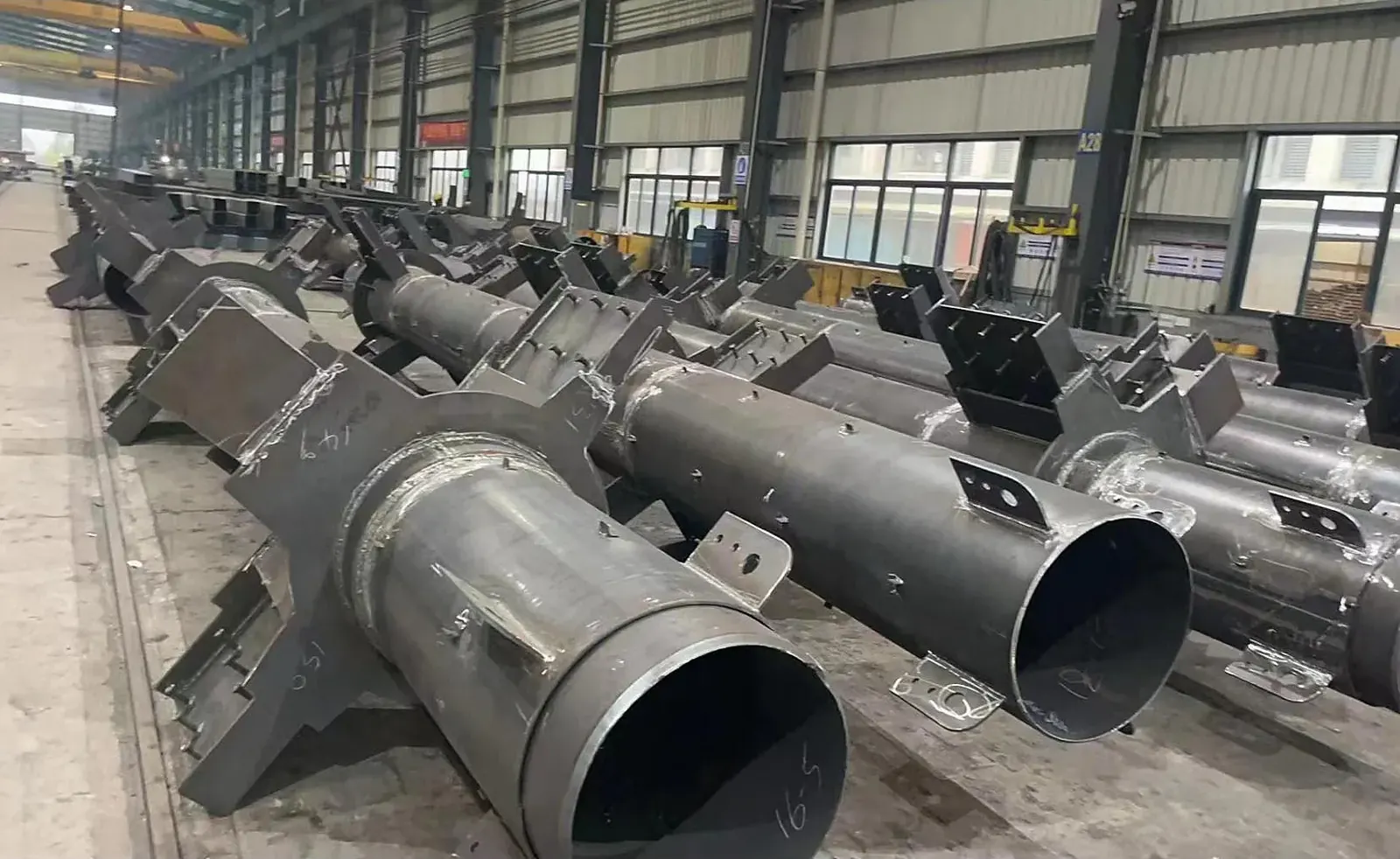
Members are loaded only after the system reaches handling cure per the paint data sheet.
Timber dunnage and slings
Soft slings, timber spacers and edge protectors. No chains on finished surfaces.
Container ventilation
Desiccant bags in 40HQ containers on routes over 7 days to limit condensation.
Touch-up kit
Primer and top coat in matching colour, 1–2% of paint volume, with repair procedure.
Coating and fire protection questions
Not sure about the corrosivity category? Send the site address with your drawings and our engineers will classify it.
Which coating system do I need for a coastal warehouse?
Most coastal sites within 1–3 km of the sea fall into C4 or C5. A zinc-rich epoxy, epoxy MIO and polyurethane system at 260–320 µm total DFT is typical. Send the site location and we will propose a system.
Should I galvanize or paint?
Galvanizing is usually more economical for secondary steel and open structures under 13 m long. Heavy primary members, box columns and long trusses are usually painted. For C5 and CX, a duplex system combines both.
Can you apply intumescent coating in the shop?
Yes. Thin-film intumescent for R60 to R120 is applied in covered halls with a thickness log for each member. Connections and transport damage are touched up on site.
Which paint brands do you use?
We work with international brands such as Jotun, Hempel, International (AkzoNobel) and Sherwin-Williams, and with approved Chinese brands. Specify your brand or let us propose one.
How is coating priced?
Usually per tonne of steel, based on the paint surface area from the Tekla BOM. A C3 system typically adds USD 80–150/t, C5 USD 150–260/t and HDG USD 250–400/t, confirmed per quotation.
Send your drawings. Get a 24-hour BOM and FOB price.
DWG, IFC, Tekla or PDF. Engineering review by our Tekla team, from 50 t or 2,000 m².